Hidden letters and numbers: a field guide
Imagine a branch that bends into a "Y," a fence rail that looks a lot like an "I," a round shadow that's secretly an "O." In hidden letters and numbers games, you're not hunting for objects at all. You're hunting for the alphabet, camouflaged in the scenery. Here's a quick field guide, built around the questions players ask us most.
Why are they so tough to see?
A letter has no color or volume to make it stand out. It's just a shape made of strokes, and a scene full of branches, stripes and railings is nothing but strokes. Your brain is stuck: anything could be a letter, and nothing is one until you've picked it out.
Where should I look first?
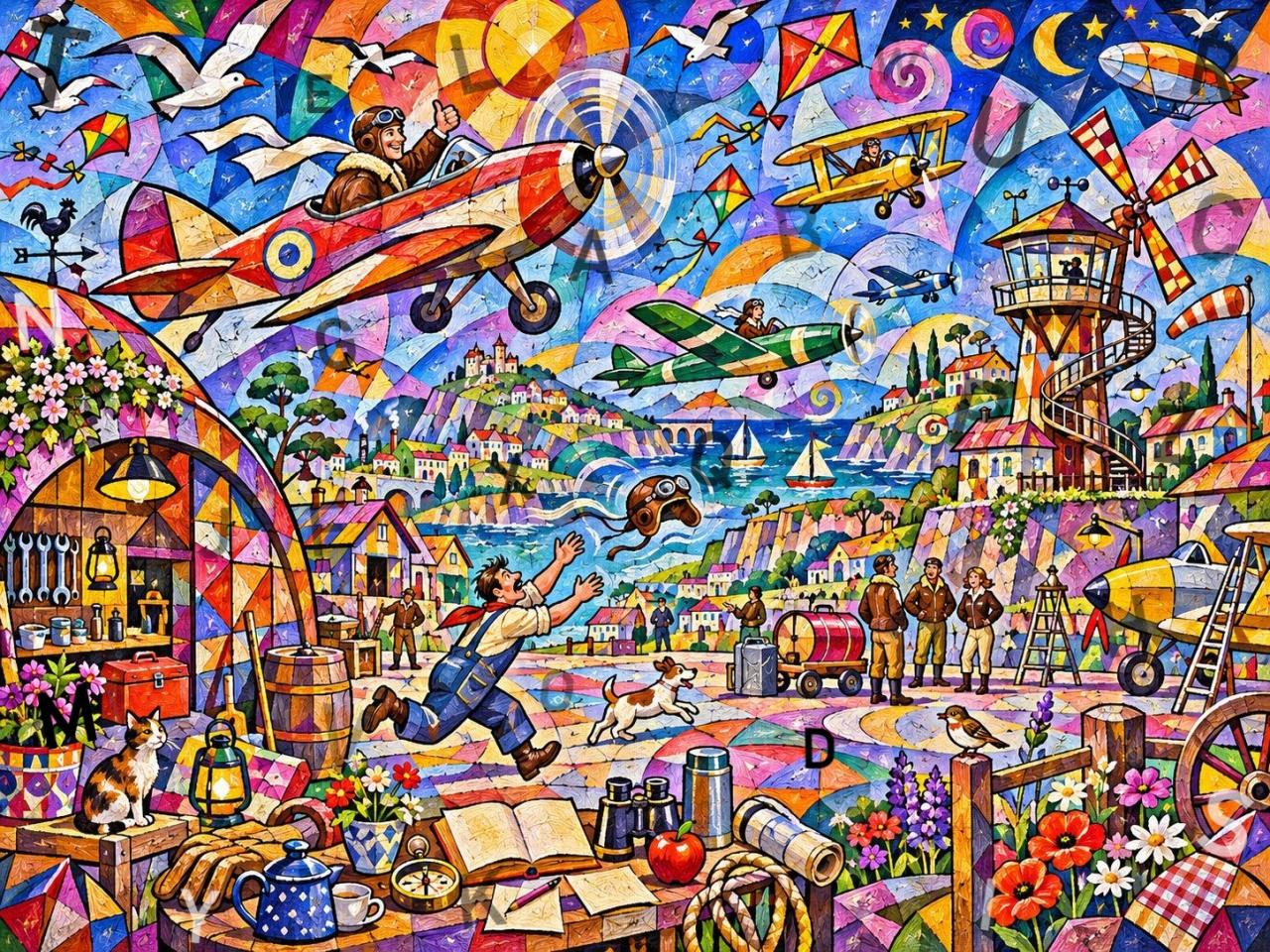
Anywhere the scenery is rich in lines: foliage, shutters, fabric, woodwork, fences. For a good example, open the shore of a frozen lake, where the planks of an overturned boat and the birch branches give you strokes pointing in every direction. Or try the flying lunatics, whose colorful patchwork hides entire letters.
Which letters are easiest?
Start with the simple ones: "I" (a bar), "O" (a circle), "L" (a right angle), "V" (a point). The curvier letters like "S," "R" and "G" come next, and usually take the longest. Numbers follow the same rule: a "1" or a "0" shows up much faster than an "8" or a "5."
Do I have to find them in order?
Nope. But it makes a fun game for two: one person calls out a letter, the other hunts for it. You can also spell out a word or someone's name by finding its letters one at a time. Try spelling your own, or the name of your dog.
What if the letters are tilted?
They often are, and that's one of the traps. An "N" on its side turns into a "Z," and an upside-down "M" looks like a "W." If you're stuck, tilt your head, literally. It works.
Is this good for learning the alphabet?
It's a nice activity with young kids who are just meeting their letters: look for the first letter of their name, then compare it with the one in a sibling's. But it's a game, not a reading program. Think of it as a fun add-on to school and storytime, not a replacement for them.
And the numbers?
Same idea, just with the digits 0 through 9. In the hidden numbers games you spot single digits that blend into natural shapes, like a "7" made from a broken branch or an "8" made from two stacked circles. Levels run from a clearly visible digit to a very well disguised one, so ease in gently.
Ready to give it a go? Head over to the hidden letters page and see how many you can spot.
Your turn to play
Ready to put it into practice? Start with today's game, or browse the hidden objects, hidden letters, hidden numbers and spot the difference games. New here? How to play takes about a minute.
More guides
- How to find hidden objects faster: 10 tricks that actually work
- Hidden object games with kids: what works at each age
- Hidden object games for grandparents and other relaxed players
- Where hidden object games come from
- Behind the scenes: how a hidden object scene gets made
- Spot the difference: a step-by-step game plan
- Brain games? What hidden object scenes really ask of you
- Comfortable screen play: setup, lighting and breaks
- Ten things to do with a hidden object scene
- Our Christmas and winter scenes, from cozy to tricky
- Hidden objects or hidden details: which one suits you?
- How to run a hidden object contest (family, classroom, club)